Comparisons to Other Libraries and Languages
Boost.SafeNumbers is one of several efforts to make numeric code safer. This page first situates the library among the existing C++ safe-integer libraries and the strong-typing facilities of other languages, then compares Boost.SafeNumbers and Boost.SafeNumerics in detail.
Feature Matrix
The matrix below compares Boost.SafeNumbers against the closest C++ libraries (Boost.SafeNumerics, bounded::integer, and type_safe) and against the strong integer typing found in Ada/SPARK and Rust.
"Yes" and "No" describe the default, out-of-the-box behavior; cells note important qualifications inline.
| Feature | Boost.SafeNumbers | Boost.SafeNumerics | bounded::integer |
type_safe |
Ada / SPARK | Rust |
|---|---|---|---|---|---|---|
Language / minimum standard |
C++20 |
C++14 |
Modern C++ |
C++11 |
Ada (SPARK subset) |
Rust |
Default behavior on overflow |
Throws |
Policy-dependent; the default |
Cannot overflow by construction; the result type’s bounds are widened at compile time. |
Undefined behavior (the arithmetic policy is configurable). |
|
Panics in debug, wraps in release; |
Alternative overflow handling |
Both forms: per-operation functions ( |
Selected as a template parameter on the type ( |
Prevented by construction; explicit clamp / wrap helpers. |
Arithmetic policy (undefined or checked) selectable. |
Range subtypes, |
|
Range-constrained (bounded) types |
Yes: |
Yes: |
Yes: bounds are the core abstraction, tracked and widened at compile time. |
|
Yes: first-class subtype range constraints, statically proven by GNATprove. |
No ranged integer type; only |
Implicit widening / mixed-width arithmetic |
Compile-time error; both operands must be the same type. |
Allowed; operands are promoted following C++ rules. |
Allowed; result bounds are computed from the operand bounds. |
Lossy and mixed-signedness operations are rejected. |
Cross-subtype operations require an explicit conversion. |
No implicit numeric conversion; explicit |
Implicit conversion to/from built-in types |
Compile-time error; explicit only. |
Allowed, including from |
Constructs only from values within range. |
Lossy and implicit conversions rejected; explicit only. |
Explicit conversions required. |
Explicit only. |
Compile-time-only verified construction ( |
Yes: |
|
|
|
Static checking at compile and proof time (a different model). |
|
Formal verification of the arithmetic |
Yes (model level): the fundamental operations (add, sub, mul, div, mod for signed and unsigned) were re-implemented in the Why3 platform and proven correct, and the C is a faithful transcription of the verified algorithms. The shipped C source is not itself mechanically verified. |
No formal-verification toolchain. |
No. |
No. |
Yes (source level): GNATprove (built on Why3) proves absence of overflow, range violation, and division by zero in the Ada source itself. |
No deductive proof in the standard library; type-system guarantees only (external tools such as Kani and Creusot are separate). |
GPU / CUDA device support |
Yes: usable from CUDA device code, with CUDA error reporting. |
No. |
No. |
No. |
No. |
Via external crates only; not in the standard library. |
Floating-point safe types |
Yes: safe floating-point types and |
Integer-focused; no safe floating-point type. |
Integers only. |
Yes: |
Yes: floating-point and fixed-point subtypes with range constraints. |
Primitives only; no ranged float type. |
|
Compile-time integer range and overflow safety is well-established prior art: Boost.SafeNumerics, |
Sources for the compared projects:
Boost.SafeNumerics,
bounded::integer,
type_safe,
SPARK User’s Guide, and
Rust numeric types.
The remainder of this page compares Boost.SafeNumbers and Boost.SafeNumerics in detail.
Key Differences
| Feature | Boost.SafeNumbers | Boost.SafeNumerics |
|---|---|---|
Default overflow behavior |
Throws |
With the default |
Construction |
Explicit only. Construction from |
Implicit construction from built-in types is allowed, including from |
Overflow policies |
Named free functions per-operation: |
Policy is selected as a template parameter on the type itself ( |
Mixed-width arithmetic |
Compile-time error. Both operands must be the same type. |
Allowed. Operands are promoted following C++ rules. |
Mixed safe/built-in arithmetic |
Compile-time error. Built-in types cannot be used as operands with safe types. |
Allowed. The built-in operand is implicitly accepted. |
Unary minus on unsigned |
Compile-time error via |
Allowed with |
Narrowing conversions |
Explicit |
Both implicit and explicit narrowing throw |
Bounded / range-constrained types |
|
|
128-bit integer types |
Yes: |
No: |
C++ standard required |
C++20 |
C++14 |
Type Deduction Readability
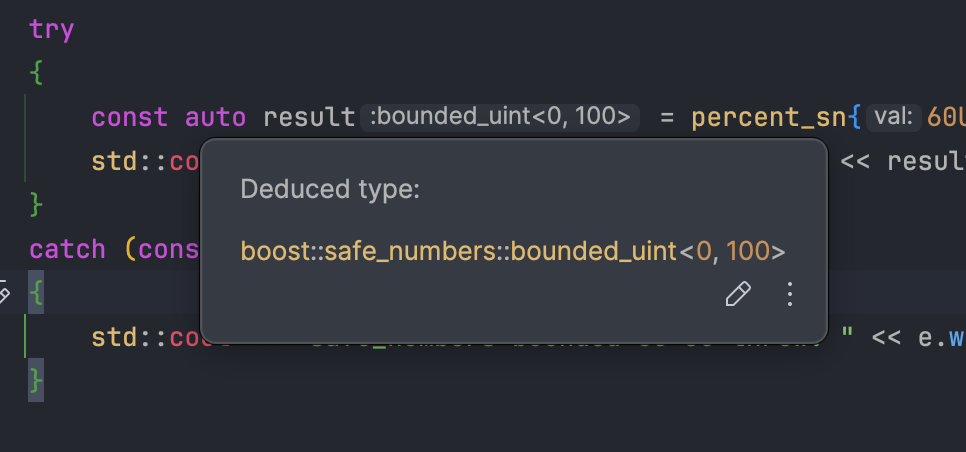
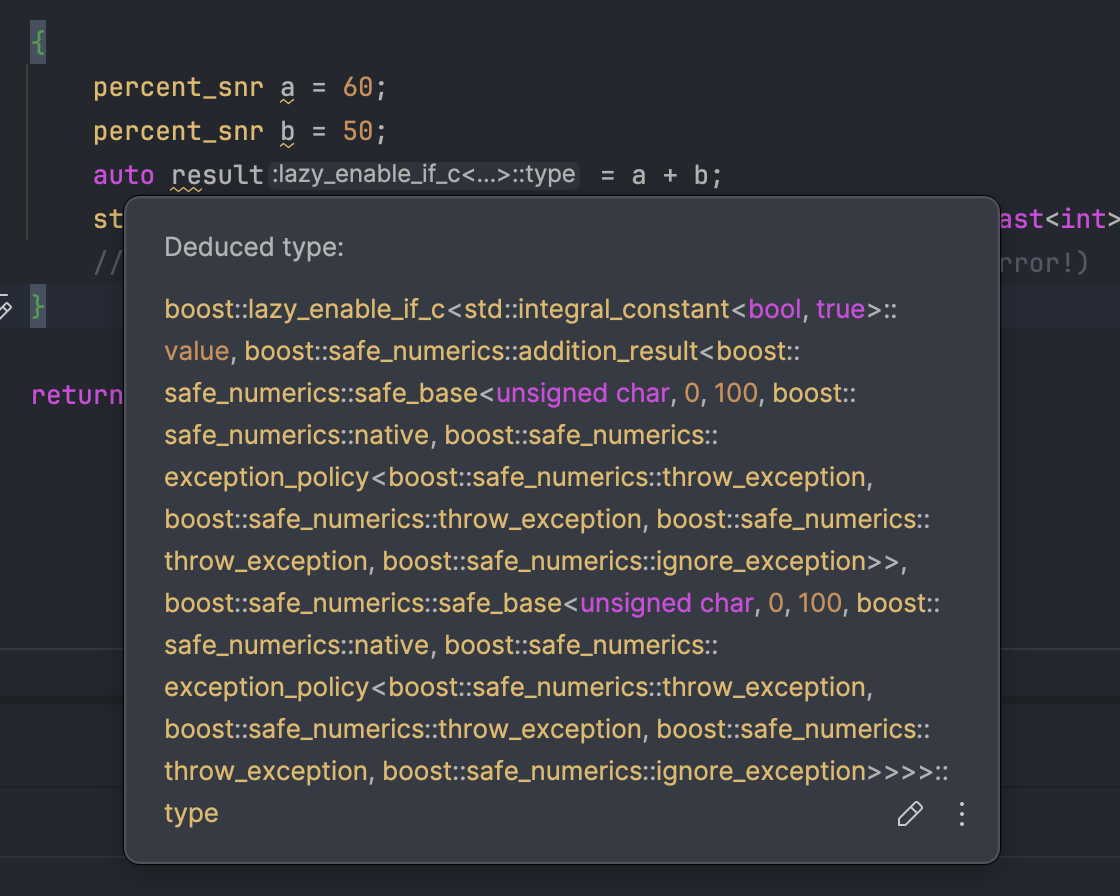
Another practical difference is how each library’s types appear in IDE tooltips and debugger output. The deduced type for bounded arithmetic results illustrates this clearly.
Boost.SafeNumbers deduces a clean, readable type:
Boost.SafeNumerics deduces a deeply nested template type that can be difficult to read at a glance:
Runnable Example
// Copyright 2026 Matt Borland
// Distributed under the Boost Software License, Version 1.0.
// https://www.boost.org/LICENSE_1_0.txt

// This example compares the behavior of Boost.SafeNumbers unsigned integer
// types against Boost.SafeNumerics for common unsigned arithmetic scenarios.
//
// Key differences:
//   1. SafeNumbers always operates at the declared width - u8 + u8 stays u8.
//      SafeNumerics with the default "native" promotion policy follows C++
//      integer promotion rules, so safe<uint8_t> + safe<uint8_t> silently
//      promotes to int. This means many overflow cases go undetected.
//   2. SafeNumbers requires explicit construction and forbids implicit
//      conversions; SafeNumerics allows implicit construction from built-ins.
//   3. SafeNumbers provides named free functions for alternative overflow
//      policies (saturating_add, saturating_sub, checked_mul, etc.);
//      SafeNumerics selects behavior via template policy parameters on the type.
//   4. SafeNumbers forbids mixed-width arithmetic at compile time;
//      SafeNumerics promotes operands using C++ native promotion rules.
//   5. SafeNumbers forbids unary minus on unsigned types at compile time;
//      SafeNumerics promotes and allows it silently.

#include <boost/safe_numbers/unsigned_integers.hpp>
#include <boost/safe_numbers/bounded_integers.hpp>
#include <boost/safe_numbers/iostream.hpp>

// Warning suppression required for safe_numerics
#if defined (__clang__)
#  pragma clang diagnostic ignored "-Wold-style-cast"
#elif defined(__GNUC__)
#  pragma GCC diagnostic push
#  pragma GCC diagnostic ignored "-Wold-style-cast"
#  pragma GCC diagnostic ignored "-Wundef"
#  if __GNUC__ >= 16
#    pragma GCC diagnostic ignored "-Wmaybe-uninitialized"
#  endif
#elif defined(_MSC_VER)
#  pragma warning(push)
#  pragma warning(disable : 4804) // Unsafe use of type bool in operation
#  pragma warning(disable : 4702) // Unreachable code
#endif

// Workaround for GCC-11 and GCC-12 not following the -Wundef pragma above
#ifndef BOOST_CLANG
#  define BOOST_CLANG 0
#endif

#include <boost/safe_numerics/safe_integer.hpp>
#include <boost/safe_numerics/safe_integer_range.hpp>

#include <iostream>
#include <cstdint>

int main()
{
    namespace safe_num = boost::safe_numbers;
    namespace safe_nrc = boost::safe_numerics;

    // -----------------------------------------------------------------------
    // 1. Construction
    // -----------------------------------------------------------------------
    std::cout << "--- Construction ---\n";

    // SafeNumbers: explicit construction only
    {
        const auto x = safe_num::u8{200U};
        std::cout << "safe_numbers explicit: u8{200} = " << x << std::endl;
    }

    // SafeNumerics: implicit construction from built-in types is allowed
    {
        safe_nrc::safe<std::uint8_t> x = 200;
        std::cout << "safe_numerics implicit: u8 = 200 -> "
                  << static_cast<int>(x) << std::endl;
    }

    // SafeNumbers forbids construction from bool (compile error):
    //   safe_num::u8 from_bool{true};  // static_assert failure

    // SafeNumerics allows it:
    {
        safe_nrc::safe<std::uint8_t> from_bool = true;  // OK, value is 1
        std::cout << "safe_numerics from bool: " << static_cast<int>(from_bool) << std::endl;
    }

    // -----------------------------------------------------------------------
    // 2. Overflow detection - the critical difference
    // -----------------------------------------------------------------------
    // SafeNumbers always operates at the declared width.
    // SafeNumerics with "native" policy follows C++ integer promotion:
    //   safe<uint8_t> + safe<uint8_t> promotes to int, so 255 + 1 = 256
    //   which fits in int - NO exception is thrown!
    std::cout << "\n--- Overflow on addition ---\n";

    // SafeNumbers: u8 + u8 stays u8, 255 + 1 overflows -> throws
    try
    {
        const auto result = safe_num::u8{255U} + safe_num::u8{1U};
        std::cout << "safe_numbers: " << result << std::endl;
    }
    catch (const std::overflow_error& e)
    {
        std::cout << "safe_numbers threw: " << e.what() << std::endl;
    }

    // SafeNumerics: uint8_t promotes to int, so 255 + 1 = 256, no overflow
    try
    {
        safe_nrc::safe<std::uint8_t> x = 255;
        safe_nrc::safe<std::uint8_t> y = 1;
        auto result = x + y;  // result is safe<int> with value 256
        std::cout << "safe_numerics: " << static_cast<int>(result) << std::endl;
        // Output: 256 (promoted to int, no overflow detected!)
    }
    catch (const std::exception& e)
    {
        std::cout << "safe_numerics threw: " << e.what() << std::endl;
    }

    // -----------------------------------------------------------------------
    // 3. Underflow detection on subtraction
    // -----------------------------------------------------------------------
    // Same promotion issue: 0u8 - 1u8 promotes to int, giving -1
    std::cout << "\n--- Underflow on subtraction ---\n";

    // SafeNumbers: u8 - u8 stays u8, 0 - 1 underflows -> throws
    try
    {
        const auto result = safe_num::u8{0U} - safe_num::u8{1U};
        std::cout << "safe_numbers: " << result << std::endl;
    }
    catch (const std::underflow_error& e)
    {
        std::cout << "safe_numbers threw: " << e.what() << std::endl;
    }

    // SafeNumerics: uint8_t promotes to int, so 0 - 1 = -1, no underflow
    try
    {
        safe_nrc::safe<std::uint8_t> x = 0;
        safe_nrc::safe<std::uint8_t> y = 1;
        auto result = x - y;  // result is safe<int> with value -1
        std::cout << "safe_numerics: " << static_cast<int>(result) << std::endl;
        // Output: -1 (promoted to int, no underflow detected!)
    }
    catch (const std::exception& e)
    {
        std::cout << "safe_numerics threw: " << e.what() << std::endl;
    }

    // -----------------------------------------------------------------------
    // 4. Alternative overflow policies (SafeNumbers only)
    // -----------------------------------------------------------------------
    // SafeNumbers provides named free functions for each policy.
    // SafeNumerics has no equivalent - behavior is fixed at the type level.
    std::cout << "\n--- Alternative policies (SafeNumbers) ---\n";

    {
        const auto x = safe_num::u8{250U};
        const auto y = safe_num::u8{10U};

        // Saturating: clamp at the max/min boundary
        const auto saturated = safe_num::saturating_add(x, y);
        std::cout << "saturating_add(250, 10) = " << saturated << std::endl;
        // Output: 255

        // Checked: returns std::optional (nullopt on overflow)
        const auto checked = safe_num::checked_add(x, y);
        std::cout << "checked_add(250, 10) = "
                  << (checked.has_value() ? "value" : "nullopt") << std::endl;
        // Output: nullopt

        // Overflowing: returns {result, overflowed_flag}
        const auto [val, overflowed] = safe_num::overflowing_add(x, y);
        std::cout << "overflowing_add(250, 10) = {" << val
                  << ", " << (overflowed ? "true" : "false") << "}" << std::endl;
        // Output: {4, true}
    }

    // -----------------------------------------------------------------------
    // 5. Mixed-width arithmetic
    // -----------------------------------------------------------------------
    std::cout << "\n--- Mixed-width arithmetic ---\n";

    // SafeNumbers: mixed-width operations are a compile-time error
    //   safe_num::u8{1U} + safe_num::u32{2U};  // fails with static_assert

    // SafeNumerics: mixed-width operations are allowed with C++ promotion rules
    {
        safe_nrc::safe<std::uint8_t> x = 200;
        safe_nrc::safe<std::uint32_t> y = 100;
        auto result = x + y;  // promoted to safe<uint32_t>
        std::cout << "safe_numerics mixed: u8(200) + u32(100) = "
                  << static_cast<std::uint32_t>(result) << std::endl;
        // Output: 300
    }

    // SafeNumbers requires explicit conversion to the same type first:
    {
        const auto x = safe_num::u8{200U};
        const auto y = safe_num::u32{100U};
        // Convert x to u32 explicitly, then add
        const auto result = safe_num::u32{static_cast<std::uint32_t>(x)} + y;
        std::cout << "safe_numbers explicit: u32(u8(200)) + u32(100) = "
                  << result << std::endl;
        // Output: 300
    }

    // -----------------------------------------------------------------------
    // 6. Mixed safe/built-in arithmetic
    // -----------------------------------------------------------------------
    std::cout << "\n--- Mixed safe/built-in arithmetic ---\n";

    // SafeNumerics: safe<T> can operate directly with built-in types
    {
        safe_nrc::safe<std::uint8_t> x = 200;
        auto result = x + 100;  // int operand is implicitly accepted
        std::cout << "safe_numerics: safe<u8>(200) + 100 = "
                  << static_cast<int>(result) << std::endl;
        // Output: 300
    }

    // SafeNumbers: mixing safe types with built-in types is a compile-time error
    //   safe_num::u8{200U} + 100;          // error: no matching operator+
    //   safe_num::u8{200U} + std::uint8_t{100};  // error: no matching operator+

    // -----------------------------------------------------------------------
    // 7. Unary minus on unsigned types
    // -----------------------------------------------------------------------
    // SafeNumbers: unary minus is a compile-time error via static_assert
    //   auto neg = -safe_num::u8{5U};  // static_assert: "Unary minus is deliberately
    //                             //  disabled for unsigned safe integers"

    // SafeNumerics: unary minus promotes uint8_t to int, so -5 is valid
    std::cout << "\n--- Unary minus on unsigned ---\n";
    try
    {
        safe_nrc::safe<std::uint8_t> x = 5;
        auto result = -x;  // promoted to safe<int>, value is -5
        std::cout << "safe_numerics: -5u = " << static_cast<int>(result) << std::endl;
        // Output: -5 (promoted to int, no error!)
    }
    catch (const std::exception& e)
    {
        std::cout << "safe_numerics threw on unary minus: " << e.what() << std::endl;
    }

    // -----------------------------------------------------------------------
    // 8. Narrowing conversions
    // -----------------------------------------------------------------------
    // Both libraries catch narrowing - this is where SafeNumerics' promotion
    // would eventually trigger an error (when assigning the promoted result
    // back to a narrow type).
    std::cout << "\n--- Narrowing conversions ---\n";

    // SafeNumbers: explicit cast throws std::domain_error if value doesn't fit
    try
    {
        const auto wide = safe_num::u32{300U};
        const auto narrow = static_cast<std::uint8_t>(wide);
        std::cout << "safe_numbers: u32(300) -> u8 = "
                  << static_cast<int>(narrow) << std::endl;
    }
    catch (const std::domain_error& e)
    {
        std::cout << "safe_numbers narrowing threw: " << e.what() << std::endl;
    }

    // SafeNumerics: implicit narrowing throws
    try
    {
        safe_nrc::safe<std::uint32_t> wide = 300;
        safe_nrc::safe<std::uint8_t> narrow = wide;
        std::cout << "safe_numerics implicit: u32(300) -> u8 = "
                  << static_cast<int>(narrow) << std::endl;
    }
    catch (const std::exception& e)
    {
        std::cout << "safe_numerics implicit narrowing threw: " << e.what() << std::endl;
    }

    // SafeNumerics: explicit narrowing via static_cast also throws
    try
    {
        safe_nrc::safe<std::uint32_t> wide = 300;
        auto narrow = static_cast<safe_nrc::safe<std::uint8_t>>(wide);
        std::cout << "safe_numerics explicit: u32(300) -> u8 = "
                  << static_cast<int>(narrow) << std::endl;
    }
    catch (const std::exception& e)
    {
        std::cout << "safe_numerics explicit narrowing threw: " << e.what() << std::endl;
    }

    // -----------------------------------------------------------------------
    // 9. Bounded / range-constrained types
    // -----------------------------------------------------------------------
    // Both libraries provide types constrained to a compile-time range.
    // SafeNumbers: bounded_uint<Min, Max>
    // SafeNumerics: safe_unsigned_range<Min, Max>
    //
    // Critical difference: SafeNumbers enforces bounds on every arithmetic
    // result. SafeNumerics only enforces bounds on construction/assignment
    // back to the range type - the promoted result of arithmetic can exceed
    // the declared range silently.
    std::cout << "\n--- Bounded / range-constrained types ---\n";

    using percent_sn = safe_num::bounded_uint<0U, 100U>;
    using percent_snr = safe_nrc::safe_unsigned_range<0, 100>;

    // Both reject out-of-range construction
    try
    {
        auto x = percent_sn{150U};
        std::cout << "safe_numbers bounded(150): " << x << std::endl;
    }
    catch (const std::domain_error& e)
    {
        std::cout << "safe_numbers bounded(150) threw: " << e.what() << std::endl;
    }

    try
    {
        percent_snr x = 150;
        std::cout << "safe_numerics range(150): " << static_cast<int>(x) << std::endl;
    }
    catch (const std::exception& e)
    {
        std::cout << "safe_numerics range(150) threw: " << e.what() << std::endl;
    }

    // Arithmetic within bounds works for both
    {
        const auto result = percent_sn{60U} + percent_sn{30U};
        std::cout << "safe_numbers bounded: 60 + 30 = " << result << std::endl;
        // Output: 90
    }

    {
        percent_snr a = 60;
        percent_snr b = 30;
        auto result = a + b;
        std::cout << "safe_numerics range: 60 + 30 = " << static_cast<int>(result) << std::endl;
        // Output: 90
    }

    // Arithmetic exceeding the declared range:
    // SafeNumbers catches it immediately, SafeNumerics does not
    try
    {
        percent_sn a {60U};
        percent_sn b {50U};
        auto result = a + b;
        std::cout << "safe_numbers bounded: 60 + 50 = " << result << std::endl;
    }
    catch (const std::exception& e)
    {
        std::cout << "safe_numbers bounded 60+50 threw: " << e.what() << std::endl;
    }

    {
        percent_snr a = 60;
        percent_snr b = 50;
        auto result = a + b;
        std::cout << "safe_numerics range: 60 + 50 = " << static_cast<int>(result) << std::endl;
        // Output: 110 (exceeds declared range of [0,100] but no error!)
    }

    return 0;
}
Output:
--- Construction ---
safe_numbers explicit: u8{200} = 200
safe_numerics implicit: u8 = 200 -> 200
safe_numerics from bool: 1

--- Overflow on addition ---
safe_numbers threw: Overflow detected in unsigned addition
safe_numerics: 256

--- Underflow on subtraction ---
safe_numbers threw: Underflow detected in unsigned subtraction
safe_numerics: -1

--- Alternative policies (SafeNumbers) ---
saturating_add(250, 10) = 255
checked_add(250, 10) = nullopt
overflowing_add(250, 10) = {4, true}

--- Mixed-width arithmetic ---
safe_numerics mixed: u8(200) + u32(100) = 300
safe_numbers explicit: u32(u8(200)) + u32(100) = 300

--- Mixed safe/built-in arithmetic ---
safe_numerics: safe<u8>(200) + 100 = 300

--- Unary minus on unsigned ---
safe_numerics: -5u = -5

--- Narrowing conversions ---
safe_numbers narrowing threw: Overflow in conversion to smaller type
safe_numerics implicit narrowing threw: converted unsigned value too large: positive overflow error
safe_numerics explicit narrowing threw: converted unsigned value too large: positive overflow error

--- Bounded / range-constrained types ---
safe_numbers bounded(150) threw: Construction from value outside the bounds
safe_numerics range(150) threw: converted signed value too large: positive overflow error
safe_numbers bounded: 60 + 30 = 90
safe_numerics range: 60 + 30 = 90
safe_numbers bounded 60+50 threw: Construction from value outside the bounds
safe_numerics range: 60 + 50 = 110